 Wire Harnesses & Cable Assembly Manufacturer Services
Focus on one-stop solutions
for wire harness
Premier Wiring Harness integration & Customization manufacturing
TRUSTED BY 500+ WORLDWIDE BRANDS OVER OUR 20-YEAR JOURNEY
Search productSearch post
Premier Wiring Harness integration & Customization manufacturing
TRUSTED BY 500+ WORLDWIDE BRANDS OVER OUR 20-YEAR JOURNEY
Abstract
Targeting the photovoltaic new energy vehicle concept that has attracted market attention recently, this paper combines the technical characteristics of the photovoltaic industry and automotive-grade requirements of the automobile industry, systematically analyzes the current application bottlenecks of vehicle-mounted photovoltaics from three dimensions: power generation efficiency, implementation cost, and safety compliance. It also sorts out the technology layout direction of the industry, providing references for technology implementation and market judgment in related fields.
With the technological iteration and cost reduction of China’s photovoltaic industry, the penetration rate of photovoltaic products in the global market, especially in African regions with sufficient sunlight resources, has increased rapidly, which has also given rise to the conjecture of integrated application of “vehicle-mounted photovoltaics + new energy vehicles”. Recently, there has been publicity about “third-generation photovoltaic new energy vehicles” in the market, claiming that vehicles can be charged 33.6 kWh after 8 hours of exposure to sunlight, corresponding to a driving range of 330 kilometers, which has aroused public expectations for the mass production and launch of solar vehicles that “can be charged while parking”.Verification based on public information shows that the publicity entity, Cheng Yaodi Automobile, previously focused on automobile export and overseas new energy vehicle maintenance as its core business, and has no public disclosure of passenger vehicle production qualification and core technology patents, so the feasibility of its products has not been verified by the industry.
The power generation logic of silicon-based solar panels, which are most widely used in mass production at present, is as follows: when sunlight irradiates the silicon wafer, photons with energy higher than the band gap of silicon materials will excite the outer electrons of silicon atoms into free electrons. The holes formed by boron and phosphorus elements doped in the silicon wafer will guide the free electrons to move directionally, thus generating usable current.
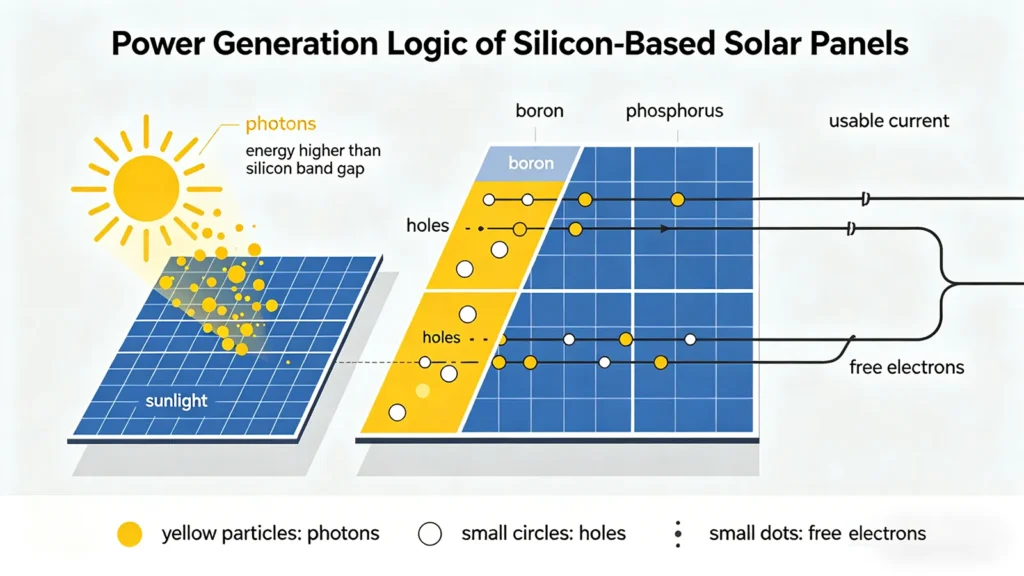
The band gap of silicon material is 1.12eV, and this physical characteristic determines the natural efficiency bottleneck of photovoltaic panels:
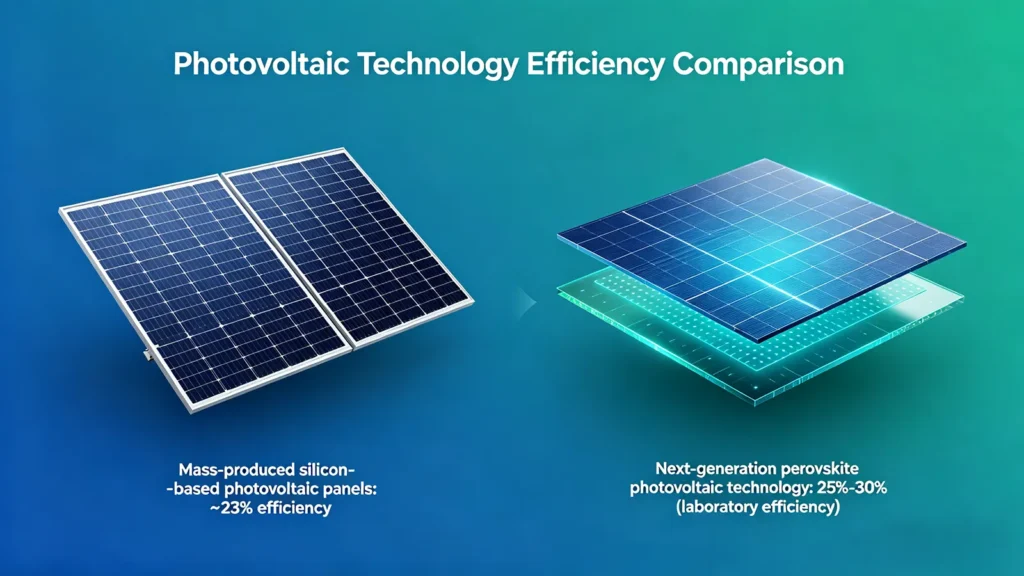
The photoelectric conversion efficiency of mass-produced silicon-based photovoltaic panels is currently about 23%. The laboratory efficiency of the next-generation perovskite photovoltaic technology can reach 25%-30%, but large-scale mass production and automotive-grade verification have not yet been achieved.
In addition to efficiency limitations, the available installation area in vehicle-mounted scenarios further compresses the actual power generation capacity:The total area of ordinary passenger vehicles where photovoltaic panels can be laid (roof, front and rear hoods, four doors) is only about 10 square meters. Affected by factors such as lighting angle, shading, and curved surface installation loss, the actual effective power generation area is less than 50% of the theoretical value. Even in areas with sufficient annual sunshine duration, the maximum power generation per hour of a stationary vehicle is only about 2kWh, which is far lower than the charging power of ordinary household charging piles.
The special application scenarios of vehicle-mounted photovoltaics put forward much higher requirements for components than ground photovoltaics, which directly drives up the overall cost:
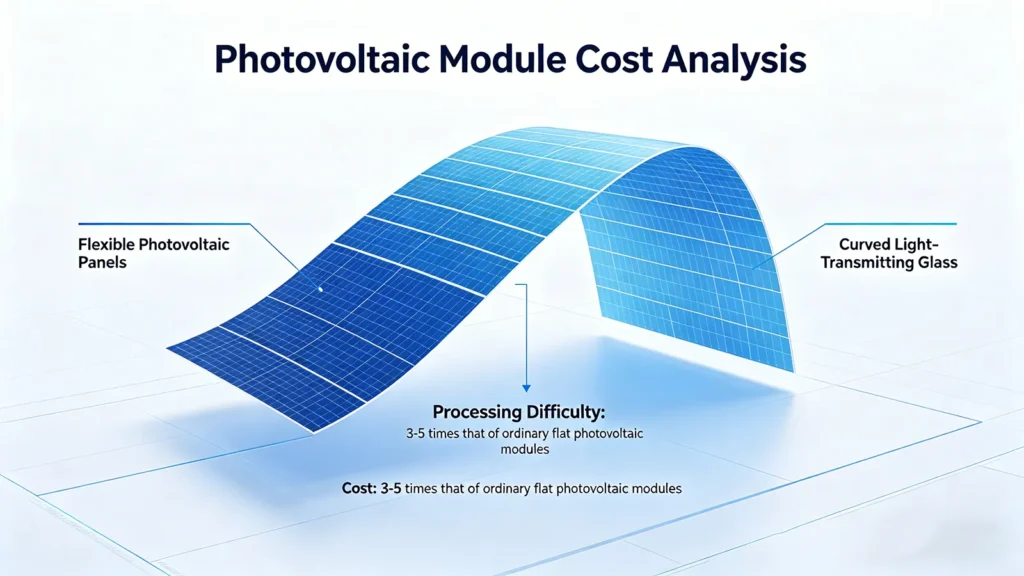
The market performance of Lightyear 0, the world’s first mass-produced solar car, confirms the cost problem: the car is equipped with 5 square meters of flexible photovoltaic panels, which can supplement 70km of driving range per day under sunlight, with a starting price of 250,000 euros (about 1.83 million yuan). The premium is significant, and the acceptance of the mass consumer market is extremely low. Its manufacturer filed for bankruptcy and reorganization in 2023.
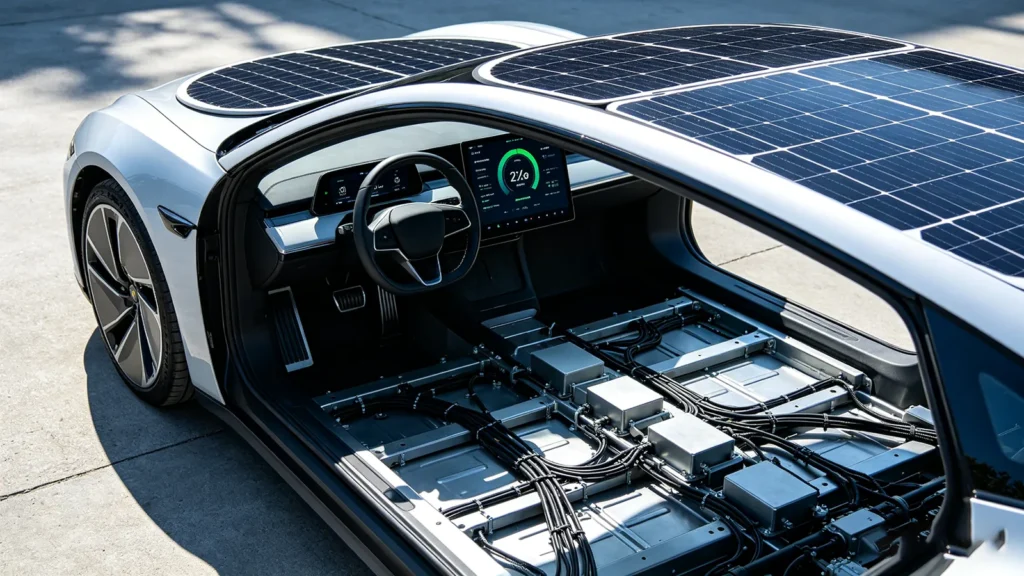
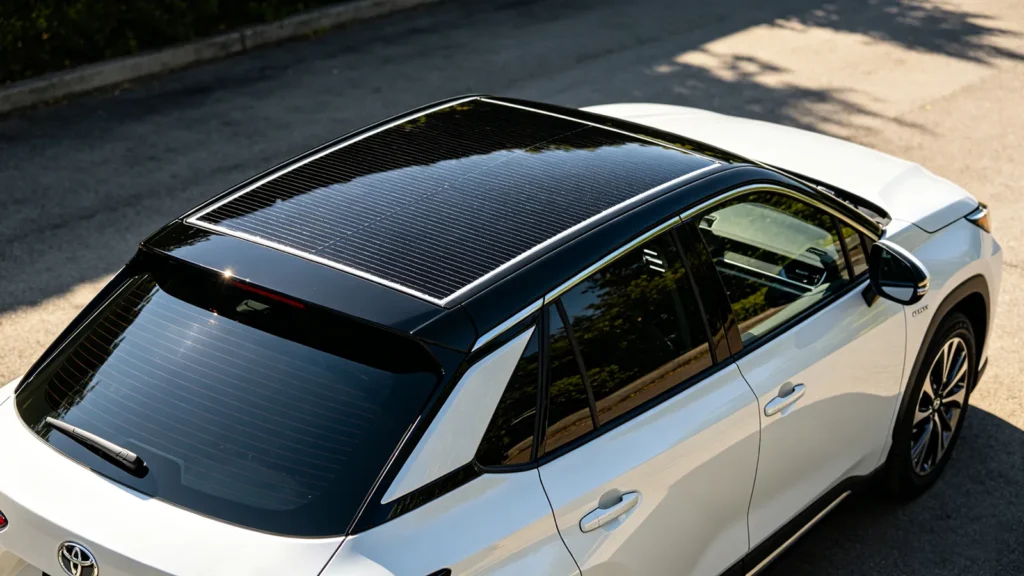
Toyota once launched a solar roof optional package for the BZ4X model, priced at about 20,000 yuan. According to official test data, it can only supplement 1800km of driving range under the scenario of 2200 hours of annual sunshine, and the converted investment payback period is more than 40 years, which only has technical symbolic significance.
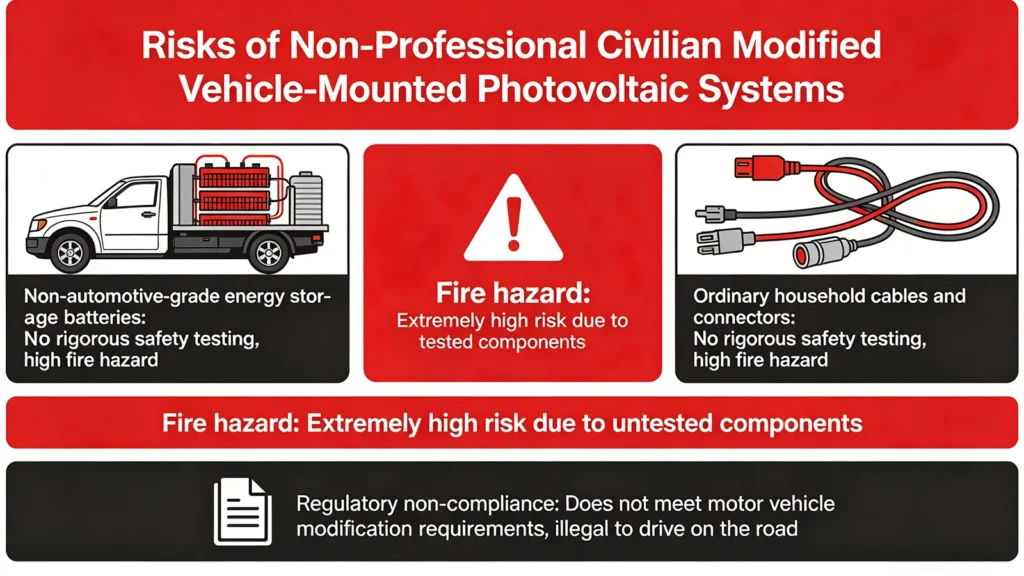
The application of vehicle-mounted photovoltaics also faces multiple safety and compliance challenges:
The current application bottleneck of vehicle-mounted photovoltaics is essentially the mismatch between photovoltaic technology efficiency and automotive-grade cost requirements, but the industry has already laid out relevant technical reserves in advance: mainstream car companies such as BYD and Geely, and supply chain enterprises such as CATL and Huawei have all carried out technical research and development of vehicle-mounted photovoltaics; the wiring harness industry is also developing lighter, thinner, and more weather-resistant integrated optical-storage-charging wiring harness solutions for vehicle-mounted scenarios.
In the future, as photovoltaic conversion efficiency breaks through the 30% mass production threshold, coupled with the cost reduction of supporting components, vehicle-mounted photovoltaics is expected to be first implemented in scenarios such as commercial vehicles and outdoor special vehicles, and gradually penetrate into consumer-grade passenger vehicles. In vehicle-mounted scenarios, the inconspicuous wiring harness system is the core carrier connecting photovoltaic power and vehicle power, and its technological iteration will be an important support for the large-scale implementation of vehicle-mounted photovoltaics.
Founded in 2007, Shenzhen Yuzhan Electronics is a national high-tech enterprise focusing on high-quality wiring harness integration and customization, providing one-stop integrated wiring harness solutions for world-renowned brands. The company has 16 years of senior industry experience in engineering technology development and production management, has passed ISO9001, IATF16949 management system certifications and 3C, UL, CSA, VDE, CE and other international authoritative certifications, and owns a number of core technology invention patents.
The company’s products are widely used in new energy vehicles, energy storage equipment, photovoltaics, intelligent robots, medical equipment and other fields, and are exported to North America, Europe, Southeast Asia, South America and other global markets. In the future, Yuzhan Electronics will continue to focus on technology research and development in the new energy field, and provide highly reliable wiring harness products and technical support for emerging scenarios such as vehicle-mounted photovoltaics and integrated optical-storage-charging systems.
EU green directives (RoHS 2.0, WEEE, PPWR) reshape wiring harness exports: PBDEs from 500→10mg/kg, 75-85% recycling mandates, PFAS ban by 2027. Solutions: radiation-crosslinked polyolefins (250°C, 30% cost cut), PPS、PTFE, modular snap-fit design ...
View details
UK zero-emission cold chain tech firm Sunswap partners with Shenzhen Yuzhan Electronics to develop custom premium wiring harnesses for electric refrigeration units. UL & IATF16949 certified cable assemblies power global green cold chain equipment....
View details
China's new EV wiring harness standards GB/T 37133-2025 & QC/T 1067-2023 mandate terminal crimping ≤0.1mm, contact resistance ≤1mΩ, V5 vibration, IP6K9K, LCP/PA66 materials. Factories need MES, laser crimpers, environmental labs (¥500k/testers). C...
View details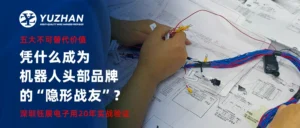
Shenzhen Yuzhan Electronics – wire harness supplier for Pudu, Keenon, Zerith, YOUIBOT. 5 values: supply security (3-month connector stock, 50ppm defect rate), cost optimization (12.7% reduction), innovation co-creation (14-day sampling), financial...
View details